
Blue Letters from Tanganyika
Commissioned by BBC National Orchestra of Wales. First performed 1997 at St. David's Hall, Cardiff by BBC National Orchestra of Wales conducted by Martyn Brabbins. Released by Ffin Records in 2009.
Orchestra: 3(III+picc).3(III+ca).3(II+Ebcl.III+bcl).2.cbn - 4.3.2.btbn.1 - timp.3perc - hp - strings
18 minutes
Commissioned by BBC National Orchestra of Wales. First performed 1997 at St. David's Hall, Cardiff by BBC National Orchestra of Wales conducted by Martyn Brabbins. Released by Ffin Records in 2009.
A musical journey inspired by the African adventures of the composer's mother.
At the age of twenty-six in 1953, Anne Ritchie set off alone for Tanganyika (now Tanzania), with an annual salary of £30 and the task of managing every school in an area the size of England. For two years she travelled on foot and by canoe across the water and wild country, and her letters tell of an exotic, exciting world, with “children doing arithmetic on their bare arms,” and where schoolgirls are startled by a python “but killed it quite happily!”
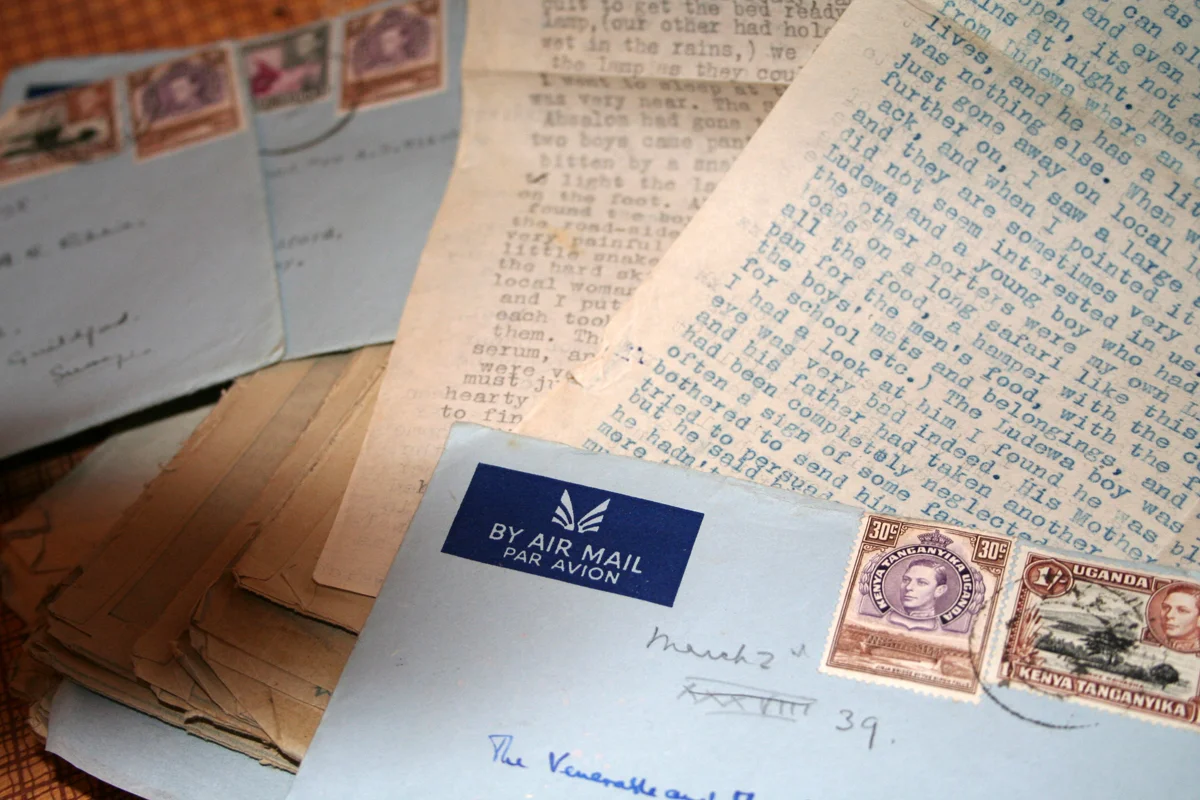
Forty years after she returned, her son John Hardy began discussions with the BBC National Orchestra of Wales about composing a new piece for a series of concerts. John's inspiration came from the exotic stories told by his mother her letters home, and these blue airmail letters gave the piece its name. “What I did was to use them as the basis for a sort of tone poem,” explains John, “describing in music some of the colour and drama of her time there.”
The 18-minute piece is in four movements, each based on a different part of Anne’s travels: ‘Arrival at the Lake’ after a dangerous night journey through lion territory; ‘Travel on the Lake’, sometimes tranquil, sometimes stormy and always filled with crocodiles and hippos; ‘Twilight on the Lake’ through the stillness of a long African night; ‘On Safari’, with the excitement and fear of the unknown.
Full of exuberant African colours, the piece is rich with imagery and imagination. Anyone who likes classical, orchestral and big film scores will feel instantly at home. Fresh and bold, Blue Letters from Tanganyika conjures an exotic world where lions are banished by bicycle bells, snakes are frightened away with hymns and the only person who can cure an aching tooth is a German nun.
Also at Amazon, Amazon MP3, iTunes and all major download stores. 25p of each CD sale from this site is donated to health and education charities working in Tanzania.
"The rhythmically charged, open and immediately engaging music is bright and colourful while still managing to evoke the African landscape"
Pwyll ap Siôn, Gramophone Magazine
4 stars **** "Four colourful, finely crafted movements"
Phil Sommerich, Classical Music Magazine
"masterpiece of creation... an extraordinary piece of history"
Roy Noble, BBC Radio Wales
"Colourful, filmic, and open to pleasurable listening at a single sitting"
Howard Smith, Music & Vision
"Powerfully cinematic"
Gavin Allen, South Wales Echo
- - -
Culprit 1 remix
Culprit 1 has produced a ground-breaking remix of music from John Hardy's orchestra suite Blue Letters from Tanganyika.
John's orchesta piece is inspired by the adventures of his mother as a young woman, when she worked for several years overseeing schools in a huge area of Tanzania.
Working on his first remix of classical orchestra music, Culprit 1 was drawn in by the combination of distinctive melodies, rich sounds and a unique story. ‘I wanted to stay pretty faithful to the original tune as I liked it so much,’ he explains, ‘I also liked the fact that the music had a personal resonance for John.’
In his remix Culprit 1 built the beat from ‘recordings of people whacking stuff like pipes and doors... samples of classic 808 and 909 machines and a bit of 'mouth percussion' for good measure!’
'Culprit 1's take on the piece retains the flowing, powerful drive of the original and marries it to a light beat and twisting filters that warp and distort the music to good effect.'
BBC Music Wales
Pax, Gododdin
More about these collaborations with Brith Gof, a conceptual performance group and Test Dept., an edgy, industrial percussion group resulted in performance spectacles of massive proportions:
Pax and Gododdin are large-scale works which were performed in massive spaces such as derelict car factories, tramways, and crane factories across the UK, Europe and Latin America. Genre-defying and incorporating multi-media elements and even choreography of trains, the projects have become legendary and are unforgettable experiences in the minds thousands of spectators.
The works were made during John Hardy's 7-year role as musical director of Brith Gof, the conceptual performance troupe which toured highly physical, politically questioning, multi-discipline shows to London, Glasgow, Dublin, Europe & Latin America. Visit the Brith Gof website to find out about the company.
Pax
Oratorio: 3 female soloists, voice, drums, percussion, 4 strings, keyboards and trumpet
80 minutes
Large scale theatrical work. First performed September 1990 at St. David's Hall, Cardiff by Brith Gof.
“Pax is a breath-taking spectacle… a magnificent and chilling oratorio… every element of the piece was terrifying and magical, on an almost biblical scale.”
Joyce Mcmillan, The Guardian
Pax is a site-specific performance work which explores the way in which change can affect related people separated by location and experience.
Staged in St. David's Hall in Cardiff, the Harland and Wolff shipbuilding yard in Glasgow and the British Rail Station in Aberystwyth, Pax is described by the Guardian as a "heady mix of grand opera, performance art, physical theatre, symphonic rock, scenography and, crucially, a forceful green message". Set in a 'ghost cathedral' of scaffolding, angels fly down to Earth where they struggle to understand the toxic atmosphere humans have created.
Pax later became the basis for a radical work for the television medium which was awarded the prize for Innovation in the 1994 British Film Institute awards.

The music in Pax is performed by John Hardy with the Brith Gof Orchestra and written by John Hardy for violin, three violas, electric and acoustic basses, keyboards and samples, electronic and acoustic percussion and taped sound effects.
“Pax is a breath-taking spectacle… a magnificent and chilling oratorio… every element of the piece was terrifying and magical, on an almost biblical scale.”
Joyce Mcmillan, The Guardian, 24 September 1991
“A unique, memorable performance… great swirling banks of sound… you knew it was something special from the beginning.”
David Adams, The Guardian, 28 September 1990
Gododdin
Oratorio: trumpet, bagpipes, percussion, keyboards and tape
70 minutes
Large-scale site-specific touring music/theatre production, composed and performed in collaboration with industrial percussion group Test Dept. First performed 1988 in an abandoned car factory in Cardiff by Brith Gof and Test Dept. Filmed by Greeneye for HTV. Recorded for Ministry of Power, distr. Rough Trade International then Revolver/APT.
Gododdin, described by The Independent as an "exceptional achievement" was inspired by one of the earliest surviving examples of Welsh poetry. In collaboration with industrial percussion group Test Dept., the production included fragments of the poem sung and spoken in Brythonic and English, a highly amplified instrumental soundtrack played live and on tape, dynamic physical action, an arrangement of hundreds of tons of sand, dozens of trees and wrecked cars, and thousands of gallons of water gradually flooding the performing area during the show.
Find out more about Gododdin and watch video from the show on the Brith Gof website.
"Elemental, wild and exhilarating... an exceptional achievement"
The Independent
"The production draws the admiration which must go to any project ambitious in aim and original in execution. There is nothing humdrum about it... spectacle for the imagination.
The Scotsman
Haearn (Iron)
Oratorio: Soprano, choir, percussion, brass band and tape
75 minutes
Large-scale theatrical event.
First performed 1992 in an iron foundry in Tredegar by Brith Gof.
The Roswell Incident

Opera: Child, soprano, tenor and bass-baritone soloists, piano, 4 strings, 4 toms and pre-recorded sounds
94 minutes
Libretto by Heledd Wyn.
Commissioned by Music Theatre Wales and Eastern Touring Agency. First performed 9/05/97 at Theatre Royal, Bury St Edmunds by Music Theatre Wales.
The Roswell Incident explores the effects of the famous alleged crash in the New Mexico wilderness of an unidentified flying object in 1947, and the mythology and speculation which have surrounded the event.
Music Theatre Wales artistic director Michael McCarthy described it as "a fascinating story with strong human and emotional undercurrents... an intriguing new music-theatre piece... a cinematic piece in which image, music and message blend together."
Scored for child singer, soprano, tenor and baritone with string quartet, piano, percussion and electro-acoustic soundworld, the libretto is by Heledd Wyn.
“A powerful new opera”
Duncan Hadfield, The Independent, 3-9 May 1997
“Hardy’s approachable score… ranges from Brittenesque nerviness… to New Age, neo-minimalist lyricism.”
Rodney Miles, The Times, 13 May 1997
“Cunningly crafted… score.”
Christopher Morley, The Birmingham Post, 31 May 97
“Hardy’s fretful, quick-fire exchanges…
are witty… the vocal pointillism clicks… the odd instrumental touch (eerie, zither-like keyboard, a three-second glisten of violin harmonics) makes appealing subliminal contributions.
The focal character… seems to stand outside normal time and space… [seeming] to be an unnerving liberated reflection of ourselves… Hardy gives this young slyph recitatives ranging from minor thirds… to quite supple, intricate vocal cat’s cradles and octave pirouettes.”
Roderic Dunnett, The Independent, 3 June 97
“A remarkable topical opera… both modern and approachable, outré and understandable… [the] audience… were captivated and enthralled.”
Michael Courtney Soper, Contact International UK, 9 June 97
“Anothernotable success [for Music Theatre Wales.]”
Jon Holliday, The Stage, 3 July 97
“The piece deserves further life.”
Rodney Miles, Opera, August 1997
Flowers
Libretto adapted by John Hardy from Flowers of the Dead Red Sea by Ed Thomas. Commissioned by Music Theatre Wales. First performed at Chapter Arts Centre by Music Theatre Wales conducted by Michael Rafferty.
Opera: Soprano, tenor, bass-baritone soloists, 3 winds, violin/viola, cello, double bass, percussion
75 minutes
Libretto adapted by John Hardy from Flowers of the Dead Red Sea by Ed Thomas.
Commissioned by Music Theatre Wales. First performed 17/03/94 at Chapter Arts Centre, Cardiff by Music Theatre Wales conducted by Michael Rafferty.
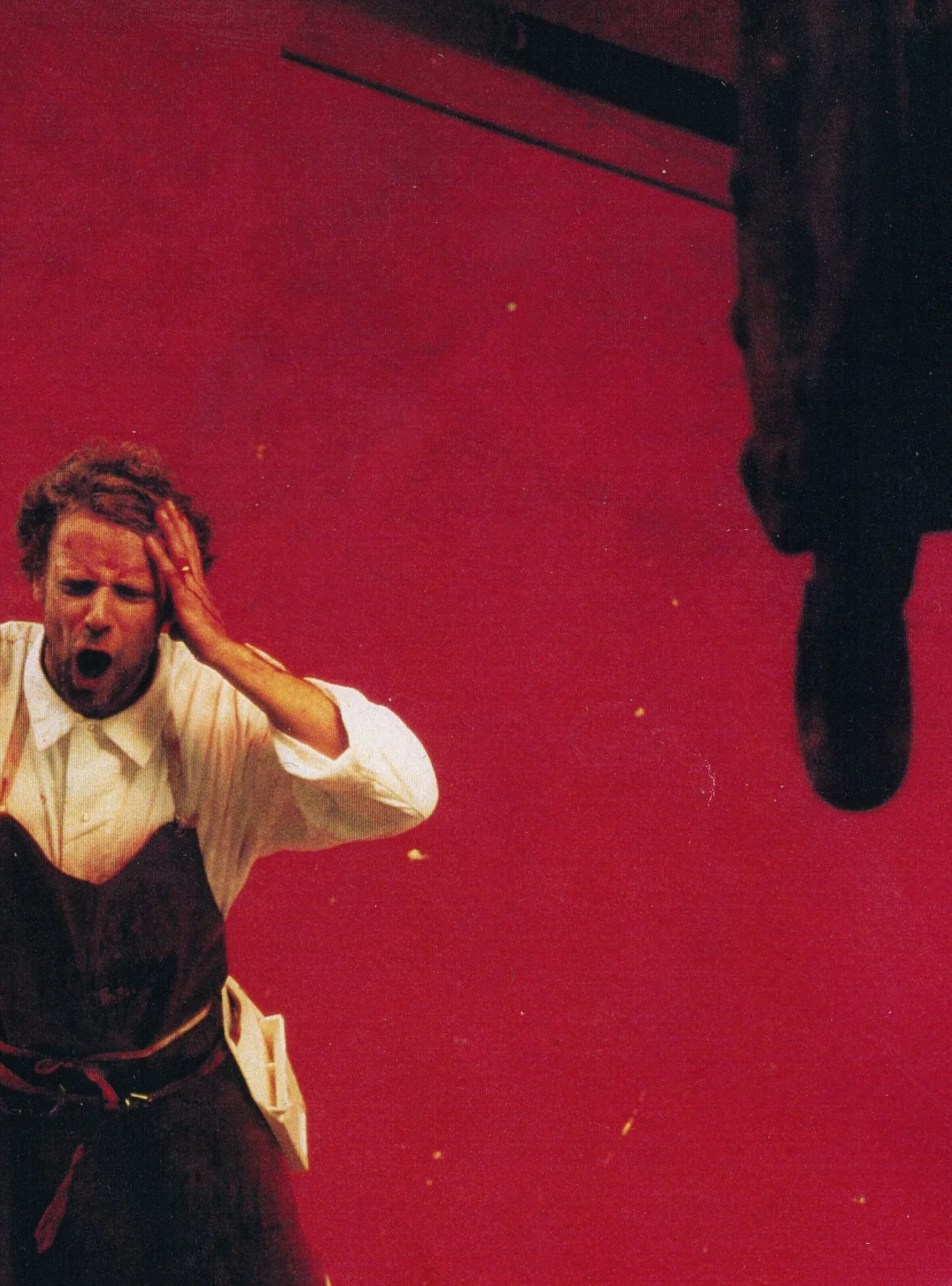
Flowers was premiered in 1994 by Music Theatre Wales and is based on the Ed Thomas play Flowers of the Dead Red Sea. It toured across the UK and Europe in 1995 and 1996 to great critical acclaim.
The opera is scored for soprano, tenor and bass singers with seven instrumentalists playing three clarinets, violin/viola, cello, bass and percussion, plus plate smashing by the conductor.
“Hardy’s 90-minute opera is gripping and intensely theatrical. He has a feeling for the dramatic ebb and flow of opera which can’t be taught but clearly benefits from his theatre and film experience… blackly humorous and ironic by turns… Hardy draws a wealth of colour…[an] important endorsement of Welsh opera.”
Peter Reynolds, Opera Now, May 1994
“The opera is driven from climax to climax by Hardy’s violent but irresistible score, rich in detail and full of diverse ideas… it creates a fierce concentration… tensions are built expertly… a message for our times, strongly delivered.”
Kenneth Loveland, Musical Opinion, May 1994
“John Hardy’s new 90-minute chamber opera for Music Theatre Wales has a lot going for it. Hardy’s energetic, instinctive music, resourcefully scored… is very much to the point, communicating with commendable flexibility the whole gamut of human emotions.”
Stephen Pettitt, The Times, 21 March 1994
“Hardy delivers his protest with conviction and with violence, and we are won to his side. The score… is rich and evocative… generous in detail.”
Kenneth Loveland, Opera, May 1994
“A very varied, wide emotional spectrum expressed”
Stuttgarter Zeitung, 7 August 1995
“Another musical hit… John Hardy’s new work Flowers is music theatre on the edge, provocative, disturbing and extremely enjoyable… a focused and highly charged piece… emotionally searing, challenging but accessible.”
Mike Smith, Western Mail, 19 March 1994
“Flowers is a strong piece that seems to do what it sets out to… with terrific conviction, with a flair for tortuous sonic imagery, and with no hint that the composer is not in complete control of his materials.”
Stephen Walsh, The Independent, 19 March 1994
“(It's) about passion, struggle and survival in a world of disappearing values. Hardy is no stranger to writing music for the stage, having produced an epic score.”
Nerys Lloyd-Pierce, Wales on Sunday, 13 March 1994
“John Hardy, an exciting composer… developed a dramatic style both accessible and challenging. An utterly engrossing piece… all quite mesmeric… a sharply defined, unique and surprising piece of music-theatre that should attract anyone who enjoys the unexpected.”
David Adams, Guardian, 25 March 1994
Venite
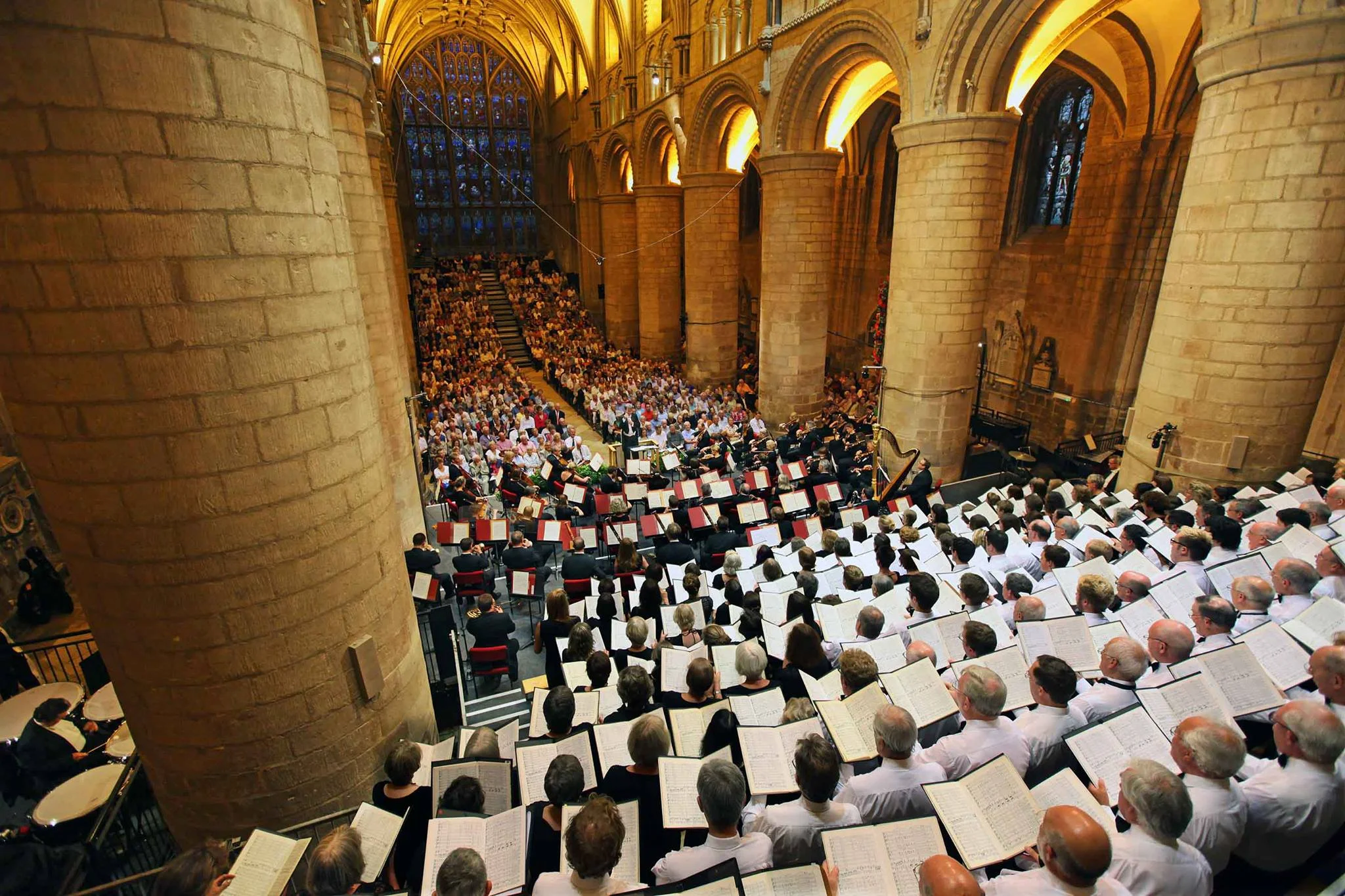
Commissioned for the opening service of the 2013 Three Choirs Festival, John Hardy's Venite is a celebratory setting of Psalm 95 (lines 1-7) beginning 'O come, let us sing unto the Lord'. Written for choir, brass, percussion and organ.
SATB choir, brass, percussion & organ
2013
8 minutes
Text: Psalm 95
Commissioned for the opening service of the 2013 Three Choirs Festival, John Hardy's Venite is a celebratory setting of Psalm 95 (lines 1-7), beginning 'O come, let us sing unto the Lord'.
Written for choir, brass, percussion and organ, Venite was first performed on 27th July 2013 by the Festival Chorus, Gloucester Cathedral Choir, RWCMD Symphonic Brass ensemble and Anthony Gowing (organ), conducted by Adrian Partington, at Gloucester Cathedral.
John writes of his aim to "see what I can find in my subconscious that may help to stir participants and listeners into a fresh and visceral encounter with the words of Psalm 95, which has been repeated daily and monthly, throughout the world, starting in the mists of Temple and Synagogue ritual nearly three thousand years ago, in Hebrew, then in Greek, Latin, Coptic, Georgian, Slav and finally every written language on the globe.
"The plainchant quoted at the beginning is Tone vi [Liber Usualis, Solemnes 1961], often used for great festivals including Easter."
joywithinsects
SATB
2001
Flexible duration
Text: Heledd Wyn
Commissioned with funding from the Gulbenkian Foundation. First performed 2001 by Heartsong Community Choir conducted by Joan Mills.
Ellen MacArthur: In the Eye of the Storm
Orchestra: 2(I+pic).2(II+ca).1.bcl.1.cbn - 4.3.2.btbn.1 - timp.2perc(II+mar) - hp - str
2003
22 minutes
This music was written to accompany a BBC One documentary following the extraordinary journey of a gutsy 25-year old who sailed into the history books to become the youngest and fastest yachtswoman to cruise around the world single-handed. The music was recorded by the BBC Concert Orchestra conducted by Michael Rafferty.
"Ellen MacArthur thrives on extremes. After her record-breaking, life-threatening performance in the Vendee Globe round-the-world race, many people thought she might relax into cosy celebrity. Her response was to announce an attempt on the Jules Verne Challenge, the record for non-stop sailing around the world. The current record is 64 days. Ellen hoped to do it in 60.
"This one-hour special on Prime follows Ellen’s challenge from start to finish: the intensive crew-selection process, the preparation of the massive boat, the ups and downs of life on board and the ultimate triumph or failure."
Beirdd Cymru (Bards of Wales)
Trumpet, SATB, narrator and harp
2003
32 minutes
Commissioned by the Welsh Amateur Music Federation with additional funding from the Friends of NYCW, PRS for Music and Arts Council Wales. First performed 24/7/03 at St. David's Cathedral, in Pembrokeshire by the National Youth Choir of Wales.
Not Darkness but Twilight
SATB choir - timp.vib.tbells - hp.org
OR SATB choir - vib - 2pno
19 minutes
Text: Aneirin, R. S. Thomas (English)
Commissioned by BBC National Chorus of Wales. First performed 31/5/04 at St. David's Cathedral, Pembrokeshire by BBC National Chorus of Wales conducted by Adrian Partington.
Not Darkness But Twilight is a choral piece setting words by R.S. Thomas.
The piece was first performed by the BBC National Chorus of Wales conducted by Adrian Partington at St David's Cathedral Festival in Pembrokeshire, Wales and broadcast on BBC Radio 3.
The work is around 20 minutes long and is scored for choir, organ, harp and percussion. The movements set words by R.S. Thomas, with the prelude setting words from Y Gododdin, the epic 7th century Welsh poem attributed to Aneirin)
1 - Prelude
2 - Relay
3 - Gone
4 - The River
5 - The Bright Field
6 - Shadows
7 - At The End
“...The Bright Field, in which a shaft of sunlight is seen as a manifestation of the divine, inspired a fluent and altogether more intense outpouring in what was essentially a heartfelt requiem for both Thomas and Hardy's own father, who died within months of each other.
... rich waves of sound in At the End.”
Rian Evans, The Guardian